
We make things happen



Capital Fatigue: An Analysis of Equity Erosion and Structural Inertia in the Chilean Mortgage System

|
📄 Book Available in spanish To ensure the highest resolution of the report and protect intellectual property rights, the official document has been hosted in our verified repository. The Architecture of a SuspicionEvery investigation has a visible and an invisible history. The visible history of this work is contained in its equations, its tables, its Monte Carlo simulations, its goodness-of-fit tests, and its laboratories of equity resilience. The invisible history, however, began long before a single line of code existed. It began with a suspicion.. For decades, I observed the inner workings of financial markets, the evolution of index-linked instruments, and the increasingly detached relationship between theoretical explanations and the concrete experience of those who interact with them. The Unidad de Fomento (UF) had historically been presented as a neutral mechanism for preserving real value. However, there was a question that never seemed to be explicitly posed: What happens if indexation is not perfectly neutral? That seemingly simple question ended up becoming the central axis of this entire investigation. What initially appeared to be a minor yield differential ended up revealing a much deeper structure. The first contribution of this work consisted precisely in abandoning the isolated observation of prices to concentrate on the observation of relationships. The objective was not to explain a rate; it was to explain a gap. And it was at that precise moment that the conceptual framework underpinning the entire research emerged. The triangulation between the international efficient rate, the indexed rate, and the marginal market rate allowed for the identification of a phenomenon that, until now, lacked an explicit formulation within traditional financial analysis: the existence of a region where arbitrage ceases to operate fully, a region where competitive equilibrium fails to completely close observed differentials—a region where the system remains trapped. The designation of this phenomenon as the Zone of Financial Entrapment constitutes one of the central conceptual contributions of this research. This is not a metaphor; it is a verifiable structural condition, an economic geometry where agents are confined between an efficient rate they cannot reach and a market rate they cannot avoid. From this observation arose a second question: If entrapment exists, what is its cost? The answer led to the formulation of the concept of Insularity Cost. This research reveals that a small, open, and highly indexed economy can generate persistent differentials that survive even after controlling for credit risk, liquidity, sovereign premiums, and conventional market factors. The Insularity Cost represents precisely this residual friction. It is not a risk spread. It is not a liquidity premium. It is not a measurement error. It is the observable manifestation of a structural disconnect between local and international financial equilibria. However, identifying a gap was not enough; it was necessary to quantify its consequences. And it was precisely there that the concept that ultimately articulated the entire research emerged: the Asymmetric Indexation Surplus (AIS). The AIS made it possible to transform an economic intuition into a measurable magnitude. For the first time, it was possible to isolate the actually observed market rate from the rate that would theoretically have prevailed under conditions of efficient convergence. The difference between the two ceased to be a mere perception and became a quantifiable object. The research then progressed from description to causality. The question shifted from how much surplus exists to what effects it produces. The answer led to a methodological decision that ultimately defined the innovative nature of the study. Instead of assuming normal distributions or linear approximations, the decision was made to directly investigate the statistical nature of the phenomenon. The results were revealing. Goodness-of-fit tests showed that the observed dynamics did not conform to the typical behavior of Gaussian systems. Asset erosion exhibited memory, persistence, and dependence. It was heavy-tailed. In other words, it showed definitive signs of fatigue. It was then that the Weibull distribution emerged as the natural mathematical language of asset erosion. The importance of this finding can hardly be overstated. The incorporation of Weibull was not simply a statistical improvement; it constituted a complete conceptual reinterpretation of the phenomenon. The system ceased to be seen as a sequence of independent shocks and began to be understood as a cumulative process of financial depletion. The temporal persistence identified through AR(1) processes, the structural dependence captured through copulas, and the presence of extreme events reflected in the tails of the distribution all converged toward the same conclusion: equity erosion was not an accident. It was an emergent consequence of the system's structure. Subsequently, the introduction of the Gamma Structural Adjustment added an additional dimension of analytical depth. Far from invalidating the results obtained using Weibull, Gamma allowed for an even more critical understanding: that the statistical strength of the fit and the economic functionality of the phenomenon do not necessarily coincide. Gamma fit marginally better; Weibull explained better. Gamma described; Weibull interpreted. Gamma quantified the friction; Weibull revealed the fatigue. This distinction ultimately became one of the most relevant methodological conclusions of the study, because it demonstrated that the best statistical fit is not always the best economic model. The research then moved into its final stage. The construction of the Pazos Integral allowed for the transformation of all previously developed components into an integrated measure of asset resilience. For the first time, it was possible to quantify the economic drift induced by the indexation system on the debtor's equity—not as an instantaneous loss, not as an accounting discrepancy, but as a dynamic trajectory of cumulative erosion. Stochastic laboratories showed that this erosion not only existed but also exhibited highly asymmetric characteristics. A relatively small proportion of extreme scenarios concentrated a disproportionately large fraction of the total economic damage. This observation naturally connected with expectations theory. If agents internalize the possibility of losses concentrated in the tails, then the phenomenon ceases to be exclusively microeconomic; it begins to acquire systemic relevance. It is precisely here that the research makes perhaps its most ambitious conceptual leap. The introduction of the endogeneity of expectations made it possible to connect an apparently local contractual friction with potential macro-financial propagation mechanisms. It was not claimed that the UF determines the exchange rate, nor that the AIS alone explains exchange rate fluctuations. The thesis defended was much more prudent and, precisely for that reason, much more robust: it demonstrated that a sufficiently persistent friction can rationally modify agents' expectations, and that, under certain conditions, these expectations can transform into an additional channel of economic transmission. The relevance of this conclusion extends far beyond the Chilean mortgage market. It suggests that certain contractual imperfections can have cumulative effects capable of spreading well beyond the markets where they originate. Ultimately, after all the models, all the laboratories, all the validations, and all the simulations, the fundamental conclusion remains surprisingly simple: the perfect neutrality of indexation could not be corroborated. On the contrary, the evidence obtained consistently points to the existence of a persistent wealth transfer associated with long-term structural friction. This structural transfer was operationalized under the following analytical ecosystem:
This is the true architecture of this research. Not a collection of techniques. Not a succession of chapters. Not an accumulation of results. But a logical and continuous chain where each component exists because the previous one demands it. From an initial suspicion to quantifiable evidence. From a professional intuition to a formal structure. From an uncomfortable question to a theory susceptible to being debated, refuted, expanded, or refined by future research. And therein lies its greatest strength. Because truly important research is not that which closes a discussion; it is that which opens one. 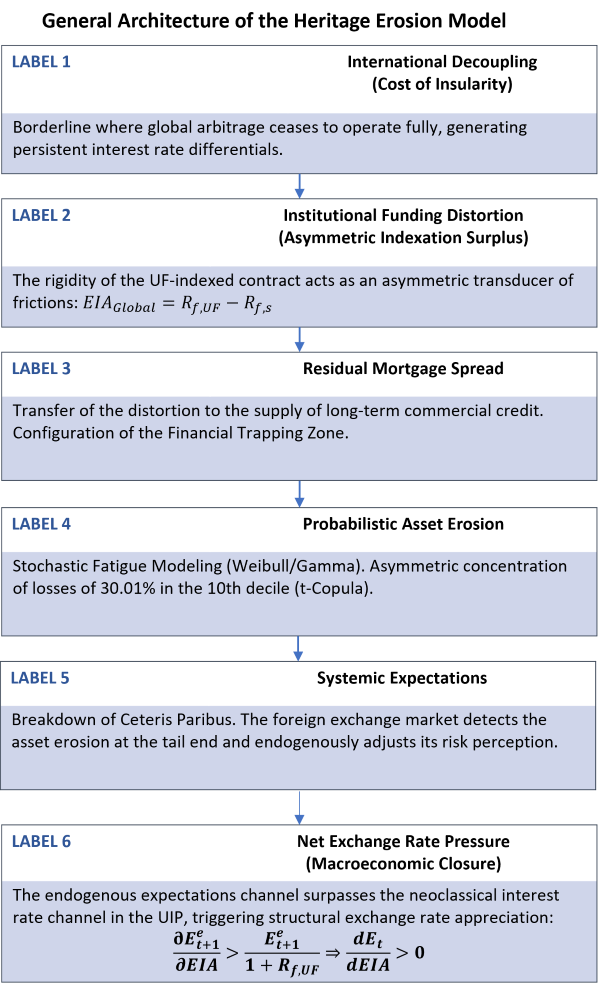 Novagestión Asesorías Financieras SpA Commitment to excellence, rigor in analysis, passion for service. 📄 Book Available in Spanish To ensure the highest resolution of the report and protect intellectual property rights, the official document has been hosted in our verified repository. |
English
 Español
 English
Premium for Implicit Risk in the Chilean Market
Ke Chilean Market IPSA as of Jul 03, 2026
| Date | Ke NOM | Ke REAL EX-ANTE |
|---|---|---|
| 26-12-2025 | 18,18% | 14,89% |
| 30-01-2026 | 21,35% | 17,97% |
| 27-02-2026 | 18,70% | 15,39% |
| 27-03-2026 | 18,00% | 14,71% |
| 24-04-2026 | 19,16% | 15,84% |
| 29-05-2026 | 21,08% | 17,71% |
| 26-06-2026 | 18,15% | 14,86% |
| 03-07-2026 | 17,22% | 13,95% |
| See Calculation Methodology |
Raising Capital & Financial Restructuring


User login
Financial Advisory


 |